

 русский
 Español
 عربى
عربى

 Home / Blogs / Industry News / How Do Air Operated Double Diaphragm Pump Manufacturers Improve Fluid Handling Efficiency
 How Do Air Operated Double Diaphragm Pump Manufacturers Improve Fluid Handling Efficiency
 2026.07.07
 Industry News
Air operated double diaphragm pump manufacturers are used in situations where fluid movement is not always stable. Some fluids are thick. Some contain mixed particles. Some change behavior during operation. There is rarely a fixed condition.
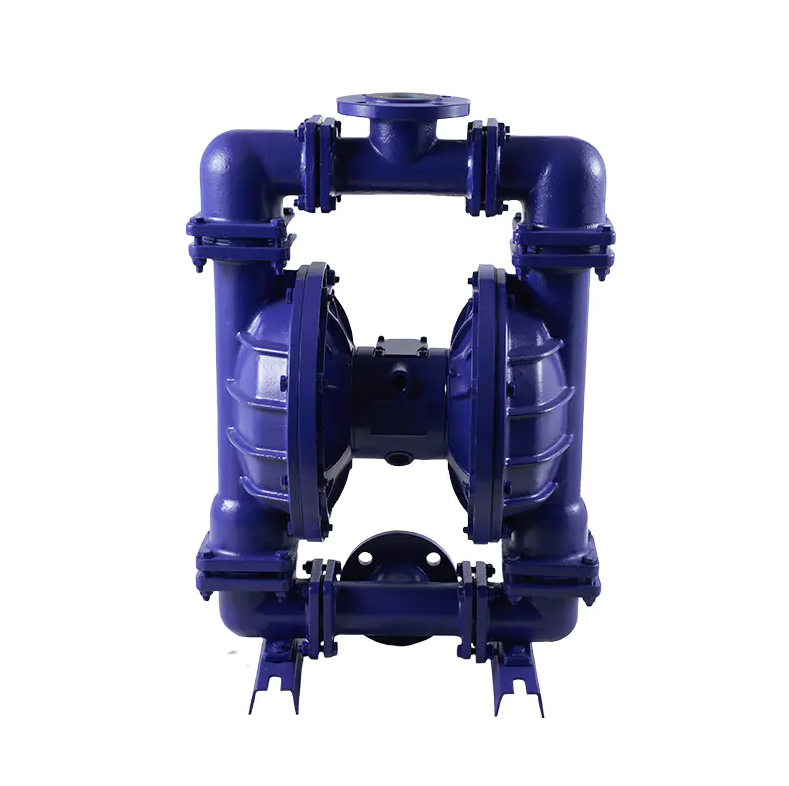
Manufacturers in this field usually focus on one simple idea: keeping flow movement steady even when the working environment changes. Efficiency is not just about output. It is more about how stable the system feels during long use.
Instead of chasing a single "fast result," the focus is often on balance, consistency, and reduced interruption.
What Does Efficiency Mean in Real Fluid Handling Work?
In real applications, efficiency is not a clean number or fixed outcome. It shifts depending on how the system is used.
A pump may perform well in one condition but behave differently when the fluid changes. Because of this, manufacturers often think in terms of "behavior stability" rather than pure output.
If a system keeps running without frequent adjustment, it is usually considered more efficient in practice.
There is also another layer. In many industrial environments, even small interruptions can slow down the entire process. So reducing fluctuation becomes just as important as improving movement speed.
How Do Manufacturers Improve Flow Stability Inside the System?
A lot of effort goes into internal movement paths.
Fluid does not just pass through a pump. It follows shaped channels, pressure changes, and directional shifts. If any part of this movement is too sharp, the flow becomes uneven.
Manufacturers often try to soften these transitions. Not by adding complexity, but by removing unnecessary resistance inside the structure.
Small changes in internal shape can create noticeable differences in real use. A smoother path usually means fewer interruptions.
There is also attention to balance. When movement inside the system is uneven, output becomes unstable. So internal symmetry and alignment are often quietly adjusted during production design.
Where Do Improvements Usually Happen in Fluid Handling Systems?
Most improvements are not visible from the outside. They are spread across different small design areas.
Here is a simple breakdown:
| Focus Area | What It Affects in Practice | Why It Matters |
|---|---|---|
| Internal flow path | Smoothness of fluid movement | Reduces resistance and uneven flow |
| Material surface behavior | Interaction between fluid and inner walls | Helps maintain steady movement |
| Air movement control | Timing of pump action | Supports consistent operation |
| Structural balance | Overall stability during cycles | Reduces vibration and irregular output |
| Entry and exit design | Flow transition at start and end points | Prevents sudden disruption |
These areas work together rather than independently. A small change in one part often influences the rest.
Why Does Material Behavior Matter So Much?
Materials inside the system are not just about strength. Their behavior over time plays a bigger role.
Fluids react differently depending on surface condition. Some move smoothly. Others tend to stick or slow down. Over time, this interaction affects consistency.
Manufacturers often prefer materials that stay stable after repeated use. Early performance is easy to achieve. Long-term behavior is harder to control.
Surface condition also matters. A smoother surface generally helps reduce resistance. This allows fluids to move with less interruption.
Flexibility is another quiet factor. Some parts move repeatedly during operation. If the material changes shape too easily, performance becomes unstable. If it is too rigid, movement becomes restricted. Balance is important here.
How Is Air Control Connected to Efficiency?
Air movement inside the system has a direct effect on fluid behavior.
If air flow is uneven, internal movement becomes unstable. That instability then transfers to the fluid path.
Manufacturers often work on making air distribution more even. Not stronger, but more controlled.
Timing also matters. When air input and internal movement are not aligned, the flow becomes irregular. When they are balanced, the system feels smoother in operation.
It is less about power and more about coordination.
How Do Manufacturers Reduce Flow Interruptions During Operation?
Interruptions usually come from small imbalances rather than large failures.
A slight mismatch in internal movement can create uneven output. Over time, this becomes noticeable in performance.
To reduce this, manufacturers often refine how internal components move together. Even small timing adjustments can improve flow consistency.
Another focus is entry and exit behavior. If fluid enters unevenly, the system has to correct itself internally, which affects stability. Smoother transition points help avoid this.
Instead of fixing problems later, the goal is to prevent instability at the design stage.
How Do Systems Adapt to Different Fluid Conditions?
One challenge in real use is variation. Fluids do not stay the same across all applications.
Some are light and easy to move. Others are heavier or mixed. A single system must often handle both.
Manufacturers usually design with flexibility in mind. Instead of optimizing for only one condition, they aim for a wider usable range.
Small variations in fluid behavior should not completely change how the pump performs. If the system reacts too strongly, efficiency drops.
So adaptability is built into structure, movement balance, and internal flow design.
How Does Maintenance Influence Long-Term Efficiency?
Efficiency is not only about initial performance. It also depends on how the system behaves after long use.
If maintenance is difficult, performance often declines faster. Even small buildup or imbalance can affect flow movement.
Manufacturers try to reduce this risk by making internal areas easier to access and clean.
Wear behavior is also considered. Components that stay stable after repeated cycles help maintain consistent output.
In real environments, maintenance-friendly design often matters as much as performance design.
How Do Manufacturers Keep Performance Stable Over Time?
Continuous operation creates its own challenges.
Over long periods, small changes accumulate. Temperature shifts, pressure variation, and repeated movement all influence system behavior.
Manufacturers try to reduce sensitivity to these changes. A stable system should not react too sharply to small variations.
Balanced internal structure helps spread these changes more evenly, instead of letting them concentrate in one area.
The goal is not performance. It is steady behavior over time, even when conditions are not perfect.
How Do Design Decisions Shape Real Efficiency?
Every improvement in fluid handling comes from a combination of small design choices.
Flow paths, material behavior, air control, and structural balance all interact. None of them works alone.
In practice, manufacturers adjust these elements step by step. Not in a dramatic way, but through continuous refinement.
Efficiency becomes something that is built quietly into the system, not added at the end.
Copyright © Zhejiang Zhanbo Diaphragm Pump Manufacturing Co., Ltd.

OEM/ODM Diaphragm Pump Manufacturer